









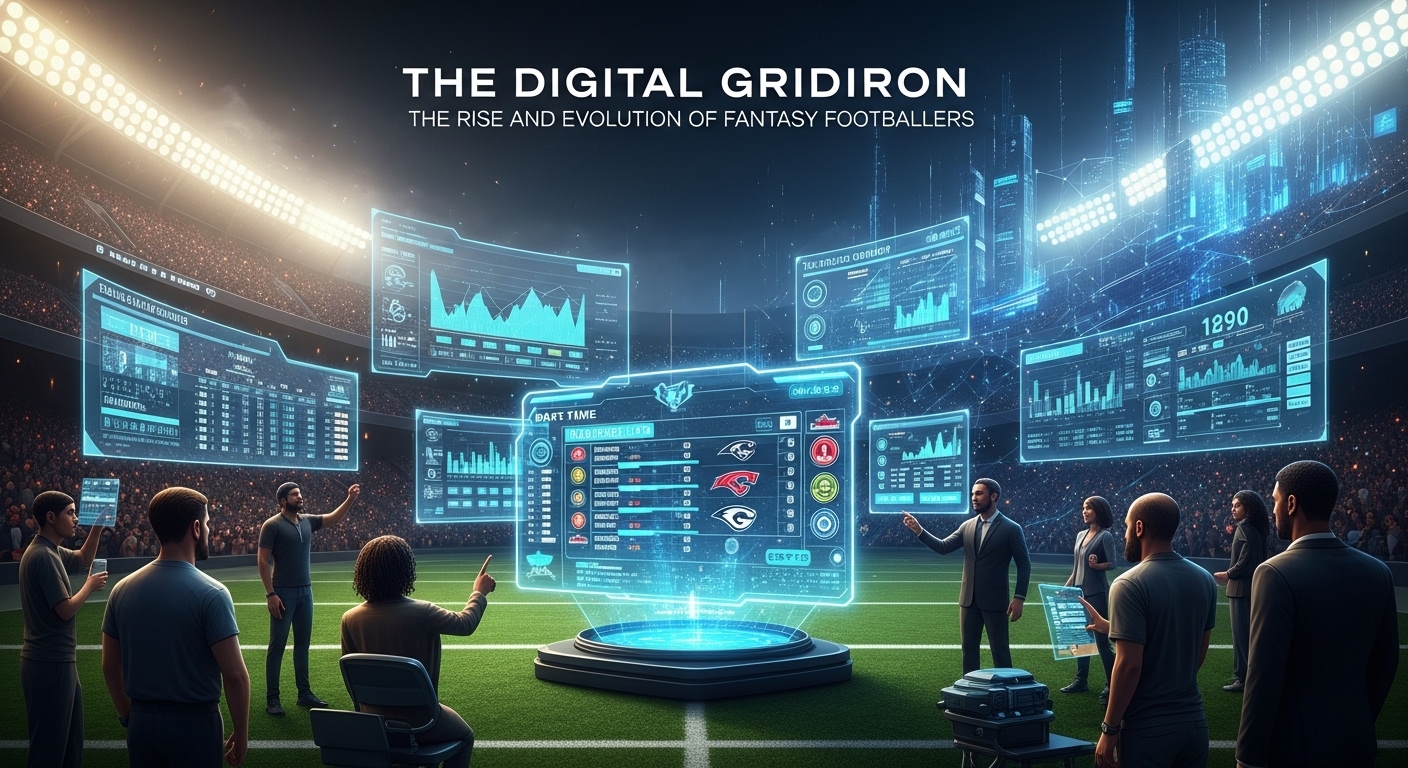
The Rise and Evolution of Fantasy Footballers
Every Sunday, millions of people around the globe undergo a strange transformation. They cease being mere spectators of the NFL and become something more: General Managers. These are the “Fantasy Footballers,” a community of fans who have turned the consumption of sports into a high-stakes game of statistics, strategy, and social rivalr.
.What started in a smoke-filled hotel room in 1962 has evolved into a global industry valued at over $38 billion in 2026. To understand the modern fantasy footballer is to understand the intersection of technology, psychology, and the unyielding human desire for competition.
1. The Genesis: From the “GOPPPL” to the Internet
The origin of fantasy football is far more humble than today’s sleek mobile apps suggest. In 1962, Bill Winkenbach, a part-owner of the Oakland Raiders, developed the first rules for what he called the Greater Oakland Professional Pigskin Prognosticators League (GOPPPL).
The Analog Era
For decades, being a fantasy footballer was a labor of love. Managers had to:
-
Manually transcribe box scores from Monday morning newspapers.
-
Calculate points using a pen, paper, and a calculator.
-
Mail or call in roster moves to a league commissioner.
The Digital Revolution of Fantasy Footballers
The mid-1990s changed everything. The launch of online platforms by CBS, Yahoo, and eventually the NFL itself, automated the “math” of the game. This lowered the barrier to entry, transforming a niche hobby for “stat-heads” into a mainstream cultural staple.
2. The Many Faces of the Game: Popular Formats
Modern fantasy footballers are no longer restricted to one way of playing. The variety of formats ensures that there is a “league” for every type of commitment level.
| League Type | Description | Best For |
| Redraft | A fresh start every year; you draft a new team from scratch. | Casual fans & beginners. |
| Dynasty | You keep your entire roster year-over-year, only drafting rookies. | The “hardcore” strategist. |
| Best Ball | No weekly management; the computer automatically starts your highest scorers. | High-volume players. |
| DFS (Daily) | A new team every week (or day) built under a salary cap. | Fans seeking instant gratification. |
| Superflex | A format allowing two Quarterbacks to be started, changing draft value. | Experienced managers. |

3. The Psychology of the Fantasy Footballers Manager
Why do we do it? For many, fantasy football provides a “skin in the game” that makes even a blowout game between two losing teams feel like a Super Bowl.
The Illusion of Control
Psychologists note that fantasy football taps into the “illusion of control.” While a manager cannot influence whether a player catches a pass, the act of deciding to start that player provides a sense of agency that traditional spectating lacks.
The Social Glue
Perhaps the most significant impact of being a fantasy footballer is social. From “smack-talk” in group chats to the infamous “league loser punishments”—which range from wearing embarrassing costumes to taking the SATs—the game acts as a vital social link for friend groups and coworkers.
Important Note: While mostly a positive outlet, recent studies from 2022–2024 suggest that “high engagement” players (those in 6+ leagues) are more prone to anxiety and mood swings based on their team’s performance. Balance is key to enjoying the gridiron.
4. Advanced Strategy: How to Win in 2026
In 2026, simply knowing who the star players are isn’t enough. The modern fantasy footballer uses a toolkit of advanced metrics to find an edge.
The “Value-Based Drafting” (VBD) Principle
VBD is the gold standard of strategy. It suggests that a player’s worth isn’t defined by their total points, but by how much they outscore the “average” player at their position.
-
Example: A Tight End who scores 15 points per game is often more valuable than a Wide Receiver who scores 18, because the “drop-off” to the next best Tight End is much steeper.
The Rise of AI and Predictive Analytics
The 2026 season has seen a massive surge in AI-driven “Draft Assistants.” These tools use machine learning to calculate the probability of a player’s injury or a “breakout” performance based on:
-
Target Share: How often a QB throws to them.
-
Air Yards: The distance a ball travels before a catch.
-
Expected Points Added (EPA): A metric measuring a player’s impact on a team’s scoring chances.
5. The Economic Juggernaut
Fantasy football is no longer just a game; it is an economic engine. In 2026, the industry is projected to grow at a CAGR of 14.3%.
-
Advertising: Brands spend billions to reach the highly engaged fantasy demographic, who spend four times as much time on sports websites as non-players.
-
Content Creation: A massive ecosystem of podcasts, YouTube channels (like The Fantasy Footballers), and “insider” subscription services has turned former hobbyists into full-time analysts.
-
The “NFL Hook”: The NFL has found that fantasy players watch more games and stay tuned in longer, even when their local team isn’t playing.
6. Common Pitfalls to Avoid
Even the best managers fall into traps. If you want to hoist the trophy this year, avoid these classic mistakes:
-
Drafting with your Heart: Never draft a player just because they play for your favorite NFL team.
-
Ignoring the “Waiver Wire”: Championships aren’t won on draft day; they are won in Week 7 when you pick up the unknown backup who just became a starter.
-
Chasing Last Week’s Points: Just because a random player scored three touchdowns last week doesn’t mean they will do it again. Look for consistency and volume over “fluke” plays.
Conclusion”Fantasy Footballers”: The Future of the Hobby
As we look toward the 2030s, the world of the fantasy footballer is likely to move into Augmented Reality (AR), where managers can see their “players” projected onto their living room floor during live broadcasts.
Whether you play for a $1,000 pot or just for the right to mock your best friend for a year, fantasy football remains the ultimate expression of modern fandom. It’s a game of “what ifs” played out in real-time, proving that sometimes, the game on the screen is only half the story.