










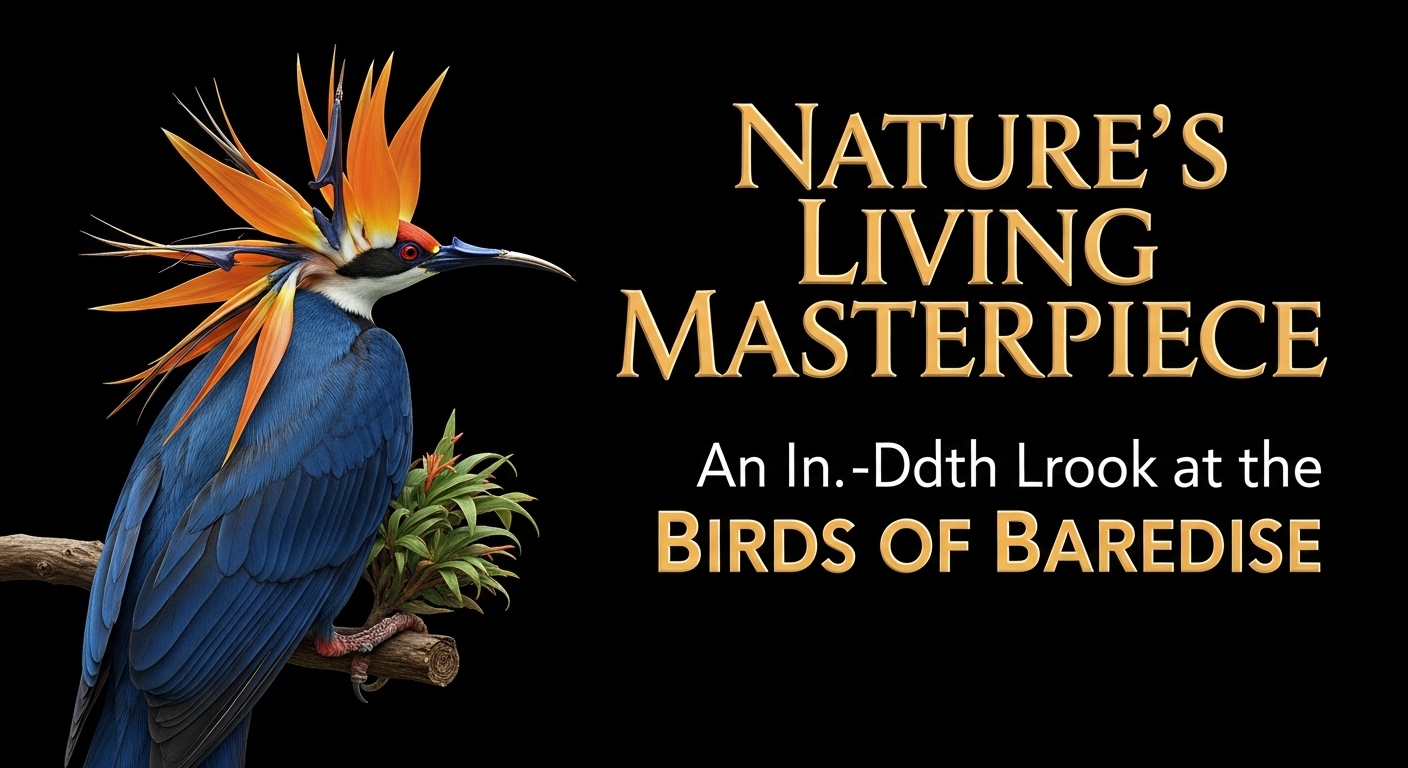
Nature’s Living Masterpiece
Deep within the dense, mist-shrouded rainforests of New Guinea and its surrounding islands lives a family of birds so spectacular that early European explorers believed they must have descended directly from the heavens. These are the Birds of Paradise (Paradisaeidae), a group of roughly 45 species that represent the absolute pinnacle of evolutionary extravagance.
While most animals evolve traits to help them survive—camouflaging from predators or sharpening claws—the male Bird of Paradise has evolved for one singular, obsessive purpose: to be noticed.

The history of these birds is as colorful as their feathers. When the first specimens reached Europe in the 16th century via Magellan’s trading ships, they arrived as prepared skins with their legs removed by local hunters.
This led to a widespread myth that these birds spent their entire lives soaring through the sky, never touching the earth, fueled only by the dew of heaven. While we now know they are very much grounded in the forest floor and canopy, the name stuck. They remain the gold standard for avian beauty.
2. Evolutionary Extravagance: Why So Bold?
You might wonder why a bird would evolve a tail three times its body length or feathers that look like iridescent breastplates. The answer lies in Sexual Selection.
The “Birds of Paradise” Role of the Female
In the world of the Bird of Paradise, females hold all the power. Because the tropical islands they inhabit are rich in fruit and lack many traditional mammalian predators, the males don’t need to spend much time guarding nests or hunting. This “leisure time” has allowed females to become incredibly picky.
Over millions of years, females have consistently chosen to mate with the brightest, loudest, and most coordinated males. This has created an “evolutionary arms race” of beauty, where only the most dazzling genes are passed on.
3. Incredible Adaptations and Plumage
The diversity within the Paradisaeidae family is staggering. No two species look—or dance—the same.
-
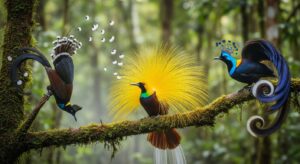
The Greater Bird of Paradise: Known for its thick, gossamer-fine yellow plumes that it raises in a shimmering fountain during displays.
-
The King of Saxony: Features two incredibly long, serrated head-wires that look like antennae. It can move these independently to “sky-fish” for a mate’s attention.
-
The Ribbon-tailed Astrapia: Holds the record for the longest tail feathers in relation to body size, trailing two white silk-like ribbons nearly a meter long.
-
The Wilson’s Bird of Paradise: Often cited as the most beautiful, it features a “turquoise crown” (actually bare skin) and
The Physics of “Super Black”
Recent scientific studies have revealed that some species, like the Vogelkop Superb Bird of Paradise, possess feathers that are among the blackest materials on Earth. These feathers have a microscopic structure that traps up to 99.95% of light. This “super black” creates a high-contrast backdrop that makes their adjacent colored patches look like they are glowing.
4. The Dance: Choreography of the Jungle
If the feathers are the costume, the mating ritual is the performance. These birds don’t just sit on a branch and sing; they perform complex, choreographed routines.
Lekking Grounds
Many species gather in a “lek”—a communal display area. Here, several males compete side-by-side, allowing the female to “window shop” for the best performer.
The Shape-Shifters
The Superb Bird of Paradise is famous for its transformation. In an instant, it flips its wings forward to become a black, oval disc with a neon-blue “smiley face” in the center. It then bounces around the female in a rhythmic, snapping dance.
Meticulous Housekeeping
Before a performance, species like the Parotia (Six-plumed Bird of Paradise) will meticulously clear their “dance floor.” They remove every leaf, twig, and pebble from their display area to ensure nothing distracts the female from their footwork.
5. Habitat and Distribution of the Birds of Paradise
The Birds of Paradise are almost entirely confined to the island of New Guinea, with a few species found in the Maluku Islands and Eastern Australia.
The Geography of Isolation
New Guinea’s rugged terrain—filled with towering mountains and deep valleys—has acted as an engine for speciation. Populations of birds become isolated by mountain ranges, evolving independently over thousands of years until they become entirely new species with unique songs and colors.
| Region | Notable Species |
| Highland Rainforests | Blue Bird of Paradise, King of Saxony |
| Lowland Swamps | Twelve-wired Bird of Paradise |
| Small Island Outliers | Wilson’s Bird of Paradise, Red Bird of Paradise |
6. Conservation Status and Threats of the Birds of Paradise
For centuries, the primary threat to these birds was the plume trade. In the late 19th and early 20th centuries, tens of thousands of skins were exported to Europe to adorn ladies’ hats. Fortunately, international laws and the decline of the feather fashion trend halted the mass slaughter.
Modern Challenges to Birds of Paradise
Today, the challenges are different:
-
Habitat Loss: Logging and palm oil plantations are encroaching on the pristine forests of New Guinea.
-
Climate Change: As mountain temperatures rise, species that live at specific altitudes may find their “perfect” environment shrinking.
-
Illegal Wildlife Trade: While protected by law, their stunning beauty makes them targets for poaching.
7. The Legacy of the Birds of Paradise
These birds are more than just “pretty faces.” They are vital to their ecosystem as seed dispersers. Because they eat a vast variety of fruits, they help plant the next generation of rainforest trees across the island.
To the indigenous people of New Guinea, the birds are culturally sacred. Their feathers are used in traditional bilas (body ornamentation) for ceremonies, representing status, ancestral connection, and the beauty of the natural world.
Conclusion “Birds of Paradise”: A Call to Wonder
The Birds of Paradise remind us that nature isn’t just about survival—it’s about expression. They are a testament to the bizarre and beautiful paths evolution can take when given enough time and the right environment.