









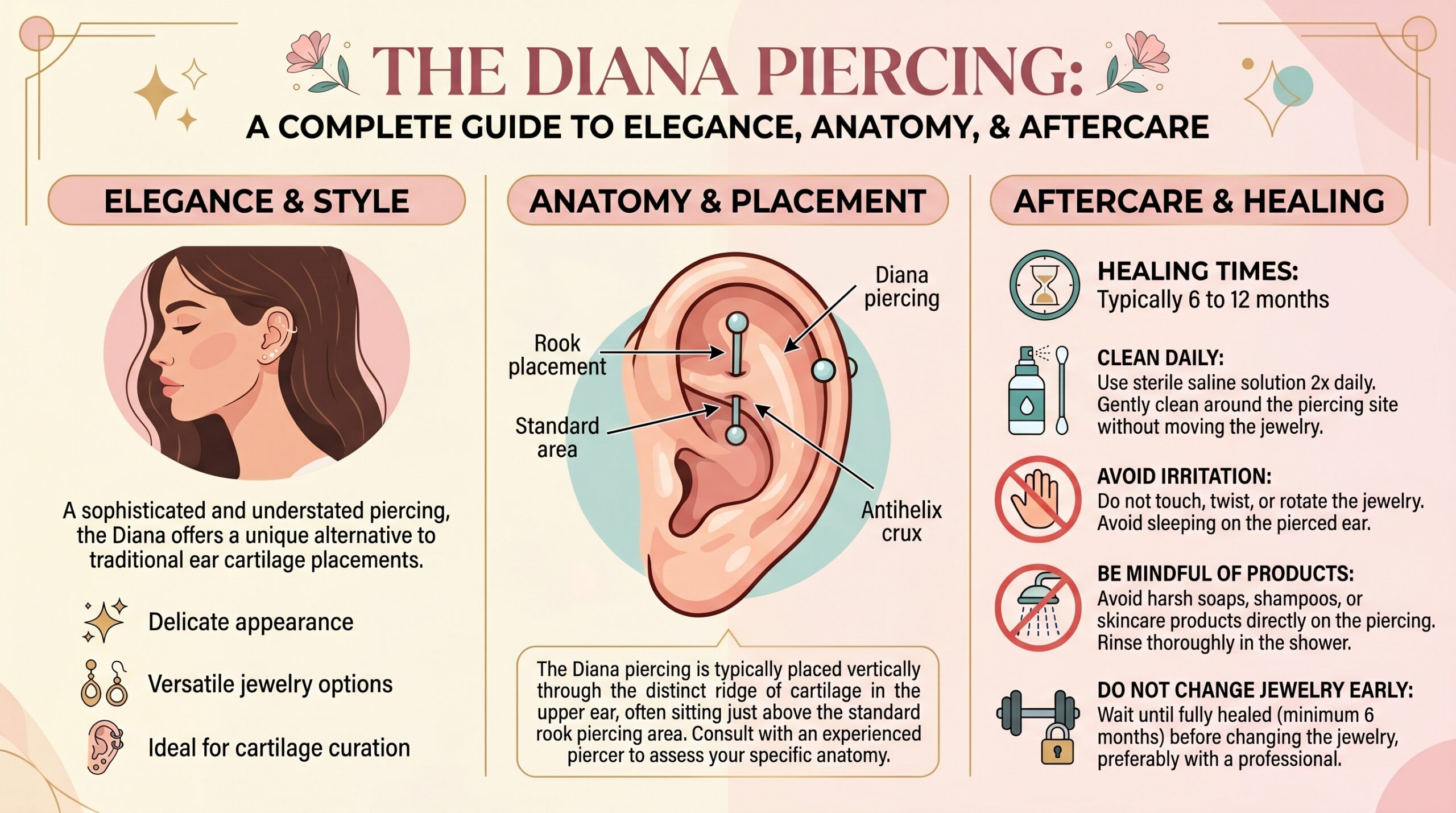
The Diana Piercing: A Complete Guide to Elegance:
Meta Description: Discover the Diana piercing, a sophisticated alternative to the VCH. Learn about its placement, benefits, pain levels, and how to ensure a smooth healing process.
The world of body modification is vast, but few categories are as personal or as transformative as genital piercings. Among these, the Diana piercing (often called the Princess Diana or Duke piercing) has emerged as a refined, symmetrical choice for those seeking both aesthetic beauty and functional enhancement.
While it shares DNA with the popular Vertical Clitoral Hood (VCH) piercing, the Diana piercing offers a unique twist that caters to specific anatomical needs and stylistic preferences. In this article, we’ll dive deep into everything you need to know about this regal adornment.
What is a Diana Piercing?
At its core, a Diana piercing is essentially an “off-center” vertical clitoral hood piercing. While a standard VCH sits directly in the center of the hood, a Diana piercing is placed to the left or right of the midline.
The Power of Symmetry: Paired Diana Piercings
The term “Diana” is most commonly used when these piercings are done in pairs. When two vertical piercings are placed symmetrically on either side of the clitoral hood, they create a balanced, framed look. This setup is often referred to as Princess Diana piercings or Duke piercings (the latter typically used in masculine or trans-masculine contexts).
Anatomy: Is the Diana Piercing Right for You?
Not all anatomy is suited for every piercing, and genital piercings are particularly “anatomy-dependent.” Before booking an appointment, it is vital to understand what a piercer looks for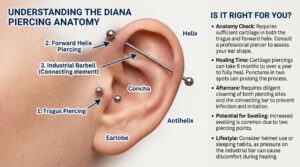
The “Q-Tip Test”
Just like a VCH, the Diana requires a clitoral hood that is thin enough to be pierced but deep enough to accommodate jewelry. A common professional test involves gently sliding a cotton swab (Q-tip) under the hood. If the hood can comfortably cover the head of the swab on the sides, there is likely enough room for a Diana piercing.
Why Choose Diana Over VCH?
-
Asymmetry Correction: Some individuals have a natural midline that doesn’t align perfectly. Off-center piercings can sometimes complement a person’s natural flow better than a forced centered one.
-
Aesthetic Preference: Many find the look of paired jewelry more visually striking than a single central piece.
-
Sensitivity: For some, a central VCH provides too much direct stimulation. Placing the jewelry to the sides offers a more subtle, secondary sensation during movement.
The Procedure: What to Expect diana piercing:
Walking into a piercing studio for a genital procedure can be nerve-wracking. Knowing the steps can help demystify the experience.
-
Consultation: Your piercer will examine your anatomy to ensure safety and proper placement.
-
Marking: The piercer will use a skin-safe marker to map out the entry and exit points. If you are getting a pair, they will spend extra time ensuring they are perfectly symmetrical.
-
Clamping: A sterilized forceps (clamp) is used to hold the tissue in place. This is often the most “uncomfortable” part for many, as it feels like a strong pinch.
-
The Piercing: A hollow, sterilized needle is passed through the tissue, followed immediately by the jewelry.
-
Final Check: The piercer ensures the beads are tightened and the placement is correct.

Pain Level
On a scale of 1 to 10, most people rate the Diana between a 3 and 5. Because the tissue of the clitoral hood is quite thin and lacks the dense nerve endings of the clitoris itself, the “sharp” part of the piercing is over in less than a second.
Jewelry Selection
Choosing the right metal and style is crucial for both healing and comfort.
Materials
-
Implant-Grade Titanium (ASTM F-136): The gold standard. It is biocompatible, nickel-free, and lightweight.
-
14k or 18k Gold: Ensure it is solid gold, not plated, to avoid irritation.
-
Niobium: Another hypoallergenic option that is slightly softer than titanium.
Styles
The most common jewelry for a is a Curved Barbell.
-
The curve allows the jewelry to sit flush against the natural contours of the body.
-
The top bead sits on the exterior of the hood, while the bottom bead rests underneath, near the clitoris.
Healing and Aftercare diana piercing:
One of the best “perks” is the healing time. Because the area has high blood flow and the tissue is mucosal-adjacent, it heals significantly faster than cartilage piercings.
Timeline
-
Initial Healing: 4 to 8 weeks.
-
Full Maturation: 3 to 4 months.
The “Golden Rules” of Aftercare
-
Saline Only: Use a sterile saline spray (like NeilMed) twice a day. Avoid harsh soaps, alcohol, or hydrogen peroxide, which can kill healthy cells.
-
Hands Off: Do not twist or turn the jewelry. Your body forms a “tunnel” (fistula) around the metal; moving it tears the new tissue.
-
Breathable Fabrics: Wear cotton underwear. Avoid tight lace or synthetic materials that can snag or trap moisture.
-
Sexual Activity: It is generally recommended to wait at least 2 to 4 weeks before engaging in sexual activity. When you do resume, be gentle and ensure both you and your partner have clean hands. Using a barrier (like a condom) can help protect the healing site from external bacteria.
Potential Risks and Side Effects diana piercing:
While generally safe when performed by a professional, all piercings carry risks:
-
Migration/Rejection: If the jewelry is too heavy or the placement is too shallow, the body may push it out.
-
Infection: Characterized by excessive swelling, green/yellow discharge, and heat. (Note: Clear or white “crusties” are a normal part of healing lymph fluid).
-
Nerve Damage: Extremely rare with a qualified piercer, but possible if the needle is misplaced.

Summary Table: Diana Piercing at a Glance
| Feature | Details |
| Placement | Vertical, on the sides of the clitoral hood |
| Pain Level | Low to Moderate (3-5/10) |
| Healing Time | 4-8 weeks |
| Jewelry Style | Curved Barbell |
| Primary Benefit | Symmetry and aesthetic framing |
Conclusion
The is a beautiful, regal addition to the world of body art. Whether you choose a single side for a touch of asymmetry or a paired set for a bold, balanced look, it offers a blend of elegance and personal empowerment. By choosing a reputable piercer and committing to diligent aftercare, you can enjoy this unique modification for a lifetime.
Ready to take the plunge? Always look for a piercer who is a member of the Association of Professional Piercers (APP) to ensure the highest standards of safety and jewelry quality.